Charter panel elects chair, opens public hearing
Bloomfield's Charter Revision Commission elected a new chair and opened its first public hearing on charter changes.
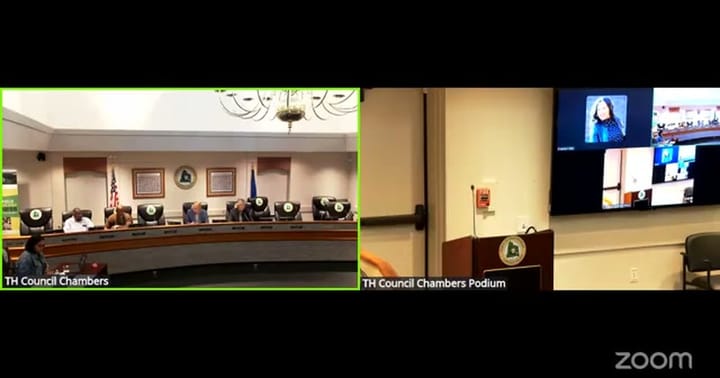
Other Committee · Meeting of September 29, 2026
Bloomfield's Charter Revision Commission elected a new chair and opened its first public hearing on charter changes. Nine residents testified, with broad support for keeping the requirement that the town manager live in Bloomfield and widespread criticism of the charter's budget referendum rules, which require a 7.5 percent voter-signature petition and a 15 percent turnout threshold. Multiple speakers, including Kate Keep and Roy Duncan, pushed for an automatic referendum triggered by a 2 to 3 percent budget increase.
Town Attorney Crumby told commissioners "it's not banned by the charter" for town employees to offer input on revisions, after Commissioner Klein raised the conflict-of-interest question. Commissioners unanimously adopted a meeting schedule through January 26, 2027, and set Sections 308 and 310, governing referendum petitions and bond issues, for review at the October 27 meeting.
In the full story:
- Who Was There
- Organizations And Documents Referenced
- The complete report — 2,055 words
Source: the Other Committee meeting of September 29, 2026, reported from the official video recording and transcript.
The Full Article
Organizational Business: Election of a New Chair
The meeting opened with a procedural snag: commissioners had to add an item to their own agenda to formally elect a chairperson, something the panel had apparently not yet done. A commissioner moved to add "the election of a chairperson" to the agenda; it passed unanimously by voice vote. A commissioner then nominated a colleague identified in the meeting only by the first name Joe, and the nomination carried unanimously. The commission's roster of named members, as stated by the newly elected chair later in the meeting, includes Commissioner Klein (referred to once as O'Kline earlier in the session), Commissioner Bolton, Commissioner Turner and Commissioner Coleman, who was absent and expected to return for the next meeting.
The Charter Revision Process: Attorney's Overview
Before testimony began, Town Attorney Crumby gave commissioners a short recap of the revision timeline for the benefit of viewers and new members. Crumby described the current session as the commission's first public hearing, intended to gather resident input before commissioners draft specific language. A second public hearing will follow release of an initial draft, which Crumby said is targeted for the end of January. "If for some reason the commission does not meet that date, council has the discretion to move or extend that date," Crumby told the panel, adding that the full project timeline is posted on the town's website. The question before the body at this stage was not any specific charter change but simply what residents want considered as the commission begins its substantive work.
Public Hearing: Term Limits, Compensation and Mayoral Selection
Several of the nine public speakers addressed the charter's basic structural provisions in Chapter 2 and Chapter 3. Donna Huggs, of 16 Brook Street, told the commission she favors keeping two-year terms for elected officials, arguing a longer term is too much for a volunteer post, though she said she would not object to staggered terms similar to the Board of Education's. She opposed any stipend for council members, citing conflict-of-interest concerns, and said she prefers the mayor continue to be selected by the council rather than through a separate townwide election, warning a direct mayoral election "would then become more of a popularity contest."
Essie LeBrow, of 12 Chateau Margot, and a subsequent commenter identified by name only when a later speaker referenced "what Councilwoman Suzette said," both told the commission they support keeping two-year terms, keeping council compensation at zero and leaving mayoral selection unchanged. The speaker identified as Councilwoman Suzette added a specific concern about internal consistency, asking that the charter's voting thresholds be reconciled with Robert's Rules of Order and standard parliamentary procedure "so that we are following the same thing." Erin Berringer, who gave her name as 28 Kenmore Road resident Erin Berringer after being announced by the moderator under a different spelling, asked the commission to standardize how the charter counts days — calendar versus business days — throughout the document.
Public Hearing: Town Manager Residency Requirement
No single issue drew more unanimous public support than the requirement that Bloomfield's town manager live in town. Essie LeBrow said she feels "very strongly" the requirement should be kept. Roy Duncan, an 18 Barn Hill Road resident of 51 years, called it "paramount" and said he wants a town manager "who has what many would say is skin in the game." Kate Keep, of 16 Breezy Mill Drive, Peter C. Frank, who identified himself as both a resident of Mallory Ridge and editor of the Bloomfield Community Dispatch, and James Biffer, of 17 Terry Plains Road, all separately told commissioners the residency requirement should stay. Biffer specifically warned that because of state statute, removing the requirement now could make it impossible to restore later: "The problem is if the charter gets passed that way, we can never put it back by state statute." No speaker argued for eliminating the requirement.
Public Hearing: Referendum and Petition Thresholds
The evening's most detailed policy disagreement centered on how residents force and decide a budget referendum. Under the current charter, as described by multiple speakers, residents must first petition 7.5 percent of registered voters to trigger a vote, then achieve 15 percent voter turnout for that vote to be valid, with the same 15 percent threshold needed to carry either a yes or no outcome. One speaker, who was not named before giving testimony, called the two-layer threshold illogical and said it "basically was put in place to avoid any opposition to a budget." That speaker proposed an automatic referendum triggered whenever a budget rises 2 to 3 percent over the prior year, eliminating the petition requirement.
Essie LeBrow separately proposed lowering the signature threshold for ordinance and referendum petitions to 4 percent and backed the existing 15 percent/simple-majority framework as an alternative path, while also recommending the budget referendum be split into separate town and Board of Education ballot questions "to give the council at least an idea of where the people are coming from." Kate Keep, who said she personally collected signatures for two years of budget petitions, argued the current structure "creates unneeded conflict in an already conflicted town" and favored a 2 percent automatic threshold modeled on her native New Hampshire. James Biffer went furthest, calling for outright removal of the 15 percent requirement in Sections 308, 310 and 906 in favor of simple majority votes, calling the current threshold "an impossible hurdle" that "basically kills opposition."
Public Hearing: Removal, Recall and Transparency Proposals
Roy Duncan asked the commission to add a recall mechanism allowing residents or the council to remove an official "deemed to be really, really out of line in their jobs." Erin Berringer asked the commission to add a clearer removal process for elected officials facing an ethics violation or investigation, distinct from the removal process for appointed staff addressed in Section 703. James Biffer asked that Section 203 vacancies be filled by special election rather than council appointment, citing what he called "the most recent egregious example" of the council filling a seat on the Town Plan and Zoning Commission with what he described as an unqualified appointee over a candidate with 35 years of relevant experience. Kate Keep separately raised a concern about how party-affiliated board vacancies are filled when no candidate of the required party applies. Duncan also told the commission that information about the charter commission itself, including meeting dates and minutes, has been difficult to find on the town website: "I'm finding nothing, frankly. And it ought to be there."
Setting the Commission's Calendar and Priorities
With testimony closed, the commission turned to logistics. Members adopted, by unanimous voice vote, a meeting schedule of October 27, November 24, December 22 and January 26, 2027, all at 7 p.m. in the council chambers, after the chair confirmed members' availability; one commissioner noted a conflict with two of the dates but said he was comfortable proceeding regardless.
The chair then proposed organizing the commission's substantive review around roughly seven or eight sections expected to draw the most public interest and consume most of the commission's time: Section 201 on elections and officers, council compensation and mayoral selection in Chapter 3, petitions for ordinances and referendums, referendums on bond issues, town manager residency and the treasurer position, and the Section 906 budget referendum. Members agreed to take up two sections per meeting, starting with Section 308, governing petitions for ordinances and referendums, and Section 310, governing bond-issue referendums, at the October 27 meeting. One commissioner asked staff to prepare comparative data in advance: a chart showing, for each of the commission's past budget referendums, the statutory signature and turnout requirements alongside the actual numbers achieved, to inform discussion of alternative thresholds such as 4 percent.
Conflict of Interest: Should Town Employees Weigh In?
Commissioner Klein raised a process question prompted by earlier public testimony: should town employees be permitted to submit recommendations on charter language, given that employees operate under the very provisions being revised. Attorney Crumby said the practice is not illegal or barred by the charter and is, in fact, recommended. "Any input given by employees is advisory only. Obviously, you folks make the determination. Nothing is binding on the part of the charter," Crumby said, adding that employees "that are doing the job that the very charter dictates they do" may have valuable perspective, to be weighed like any other input. The chair said recommendations from town staff have typically been routed through the town manager as head of administration rather than submitted individually, though he said an individual employee is not barred from testifying directly. Commissioners agreed that any correspondence received by the commission, from any source, should be made part of the public record for transparency, while noting the commission is not obligated to respond individually to each submission, only to acknowledge receipt.
Routine Business: Minutes and Closing Comments
The commission approved the minutes of its August 25, 2026 meeting by unanimous voice vote without discussion. In closing comments, one commissioner praised the tenor of the public testimony, calling the evening's exchange "a model of thoughtful interaction with a very informed public." Another commissioner asked that staff confirm the commission's online comment portal is capturing all public submissions and that submitters receive at least an acknowledgment of receipt, noting the volume of comments is likely to grow before the October meeting. The meeting adjourned on a unanimous voice vote.
Chair, first name Joe, elected during the meeting; surname not given in the transcript. Commissioner Klein, referred to once in the meeting as O'Kline; present and asked the conflict-of-interest question. Commissioner Bolton, present, named by the chair during roll of members. Commissioner Turner, present; praised by a colleague for earlier deliberative comments. Commissioner Coleman, absent; the chair said he expects Coleman at the next meeting. Town Attorney Crumby (also rendered Crumpy and Crumbly in portions of the audio), outside counsel to the commission, who presented the revision timeline and answered the conflict-of-interest question. India Rogers, identified as being with the town's communications office, referenced by a public commenter as having located a previously submitted suggestion form; not confirmed as present in the room. Donna Huggs, 16 Brook Street, public comment. Essie LeBrow, 12 Chateau Margot, public comment. Councilwoman Suzette (surname not given), public comment; referenced as a council member by a subsequent speaker. Roy Duncan, 18 Barn Hill Road, 51-year resident, public comment. Erin Berringer, 28 Kenmore Road (announced by the moderator as Eric Geringer), public comment. An unidentified speaker who addressed budget referendum thresholds and town manager residency; no name given before testimony. Kate Keep, 16 Breezy Mill Drive, public comment; described herself as a New Hampshire native and a volunteer who collected budget-referendum petition signatures for two years. Peter C. Frank, Mallory Ridge, Building 2, public comment; identified himself as editor of the Bloomfield Community Dispatch. James Biffer, 17 Terry Plains Road, public comment.
Bloomfield Community Dispatch — local publication identified by speaker Peter C. Frank as his outlet; cited in his testimony on staff involvement in charter drafting. Town of Windsor — cited by two speakers (Roy Duncan and an unidentified speaker) as a comparison town with an automatic budget referendum process and recent multi-round referendum votes. Bloomfield Board of Education — referenced repeatedly regarding staggered election terms and the proposal to separate town and school budget referendum questions. Robert's Rules of Order — cited by the speaker identified as Councilwoman Suzette as a standard the charter's voting-threshold language should be reconciled with. Town Plan and Zoning Commission — cited by James Biffer as the site of a prior council vacancy appointment he said should instead have gone to special election. Prior Charter Revision Commission (referenced as "the last commission") — cited by multiple speakers, including an unidentified commenter and the chair, as having previously debated several of the same provisions, including town manager residency. Bloomfield town charter, Sections 201, 202, 203, 302, 308, 310, 502, 604D, 703, 906 — specific sections speakers asked the commission to review, covering elections, council vacancies, mayoral selection, referendum petitions, bond referendums, town manager residency, financial claims processing, and removal of officials. August 25, 2026 commission minutes — approved without discussion at this meeting.
Share this story
Know someone in Bloomfield who follows town government? Share Townbrief Bloomfield: they can sign up free.