Charter panel lowers referendum petition threshold
The Bloomfield Charter Revision Commission voted unanimously to lower the signature threshold for citizen referendum petitions on non-budgeted town spending from 7.5 percent to 4 percent of registered voters.
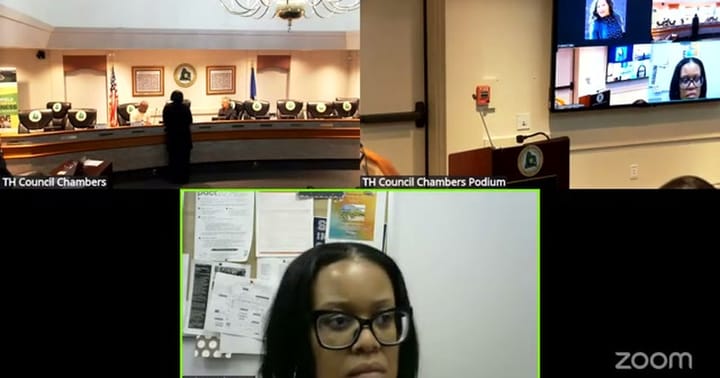
Other Committee · Meeting of October 27, 2026
BLOOMFIELD — The Bloomfield Charter Revision Commission voted unanimously to lower the signature threshold for citizen referendum petitions on non-budgeted town spending from 7.5 percent to 4 percent of registered voters. Commissioner Brad Klein, who proposed the change, said it would make petitions "less cumbersome" but acknowledged the lower bar is "extremely low, given the volatility of public opinion in a social media-saturated age." The commission also voted unanimously to amend Section 310 so that low turnout at a mandatory bond referendum would result in the bond or appropriation being "deemed approved" rather than rejected, a reversal Klein said would push opponents to "stand up and vote." Commissioner Turner said after weighing the fairness question repeatedly he found "this is not an unfair burden." Both measures still need final wording from the town attorney, identified as Attorney Crumby, before going to the Town Council. The commission also approved its September 29 minutes and set budget-referendum and council-compensation sections for its next meeting.
In the full story:
- Call to Order and Agenda
- Section 308: Referendums on Ordinances and Appropriations
- Section 310: Referendums on Bond Issues
- Minutes, Correspondence and Scheduling
- Who Was There
- Organizations And Documents Referenced
- The complete report: 1,962 words
Source: the Other Committee meeting of October 27, 2026, reported from the official video recording and transcript.
Checked against the record: before publication this article was automatically compared with the meeting transcript.
The Full Article
Call to Order and Agenda
The Bloomfield Charter Revision Commission convened Tuesday evening with all members present, including Commissioner Erica appearing remotely by Zoom. The chair opened with two agenda items carried over from a prior session: proposed revisions to Chapter 3, Section 308 (referendums on certain ordinances and appropriations) and Section 310 (referendums on bond issues). Both sections set the rules by which Bloomfield residents can force a public vote on town spending decisions made outside the regular annual budget, and both have been under review by the commission across multiple meetings as part of a broader charter revision effort requested by the Town Council.
Section 308: Referendums on Ordinances and Appropriations
Background and stakes: Section 308 governs how residents can petition for a referendum on an ordinance or appropriation enacted by the Town Council outside the normal budget process, something commissioners described as relatively rare but consequential when it occurs. The commission had developed a draft proposal in an earlier session and returned to it Tuesday to confirm or revise it before taking a vote.
The question before the body: Whether to formally adopt the commission's earlier proposal to lower the petition-signature threshold needed to trigger a referendum under Section 308, and whether to clarify ambiguous language in the section's title.
Substantive content: The existing charter sets the petition threshold at 7.5 percent of eligible (registered) electors. The commission's proposal, reaffirmed Tuesday, lowers that to 4 percent. Based on town registration figures discussed at the meeting — roughly 15,246 registered voters — Commissioner Turner calculated that 4 percent equals about 610 signatures, compared with roughly 1,143 under the current 7.5 percent threshold. The commission left unchanged the existing requirement that total referendum turnout equal or exceed 15 percent of registered voters for the result to be binding, and that a simple majority of votes cast determines the outcome. Commissioners also debated the section's reference to "certain ordinances," with several members, including Commissioner Bolton, questioning whether removing the word "certain" might broaden the section beyond its intent. The commission's attorney, identified during the meeting as Attorney Crumby, clarified that the section's scope is defined later in the same sentence, by its reference to ordinances passed under Section 307 related to non-budgeted appropriations, and that dropping "certain" would not change that scope.
The deliberation: Commissioner Klein, who introduced the proposal in an earlier session, reaffirmed his support for the 4 percent threshold Tuesday but flagged a concern about how easily such a threshold could be met. "Yeah, I think the 4 percent is extremely low, given the volatility of public opinion in a social media-saturated age. It's a concern I have," Klein said. Commissioner Turner raised a separate, more structural concern, questioning what kind of "ordinance" the charter's drafters had in mind in 2015 and whether removing ambiguous language risked eliminating a protection without understanding what it was protecting. "If we're throwing it away, are we depriving either the citizens or the council of an important situation that will only become apparent once the council tries to do something," Turner said, prompting the chair to ask Attorney Crumby for clarification while discussion continued. One commissioner, whose identity was unclear in the recording, raised a broader concern about the commission "creating more and more openness and uncertainty as to who is governing the town," arguing for tightening rather than loosening referendum access given what the speaker called the current political "culture of the council." Commissioner Klein responded that he was treating off-budget appropriations differently from the annual budget referendum process, saying he was "very comfortable with people's ability to ratify" council spending decisions made outside the normal budget cycle, even at a lower signature threshold.
Procedural steps and outcome: Commissioner Turner moved to retain the commission's prior proposal: a 4 percent petition-signature threshold, with the existing 15 percent participation requirement unchanged. Commissioner Klein seconded. The motion carried on a unanimous voice vote with no stated opposition or abstentions. The commission did not formally vote on removing the word "certain" from the section's title language as a separate action, treating it instead as a drafting clarification folded into the broader motion.
Implications and what is next: If ultimately adopted by the Town Council and incorporated into the town charter, the change would roughly halve the number of signatures Bloomfield residents need to force a referendum on town spending approved outside the budget process, from an estimated 1,143 to about 610 based on current voter registration.
Section 310: Referendums on Bond Issues
Background and stakes: Section 310 is the charter's mandatory referendum provision for bond issues and non-budgeted appropriations that exceed 1.5 percent of the annual town budget. Unlike Section 308, it does not involve a citizen petition; the referendum is automatic once the spending threshold is reached. The commission had previously flagged the section's turnout-and-passage mechanics as confusing and returned to it Tuesday.
The question before the body: Whether to change how a referendum's outcome is determined when voter turnout falls short of the 15 percent threshold, and whether to adjust the automatic-referendum spending trigger or the public notice period.
Substantive content: As written, the charter provides that if turnout at a Section 310 referendum is below 15 percent of qualified electors, the bond issuance or appropriation is deemed "not approved," regardless of how the votes that were cast broke down. Commissioner Klein argued this design effectively rewards low turnout among opponents, since staying home has the same practical effect as voting no. He proposed striking the word "not" so that low turnout would instead result in the spending being "deemed approved." Commissioners discussed the dollar scale involved using a recent example: a $39 million bond issue, where Commissioner Turner noted that even a 1 percent swing represents nearly $400,000, and the group noted the town's broader bonded obligations were discussed in context of a $118 million figure cited during the meeting. The commission also confirmed language requiring that notice of a bond referendum be published in a newspaper circulating in town and posted at town hall at least 10 days before the vote, and agreed to specify that the referendum itself, not just the notice period, must be held not less than 10 days and no more than 60 days after publication of the triggering vote.
The deliberation: Klein framed his proposed change as a matter of incentives. "If the number of qualified electors voting at any referendum conducted pursuant to this section shall be less than 15 percent of the qualified electors of the town, the issuance of bonds or making of a non-budget appropriation shall be deemed approved," Klein said, reading his proposed replacement language, adding that the change "would encourage participation in those who are opposed to stand up and vote." Commissioner Turner questioned whether that was fair to residents, framing the issue directly: "My basic question is, is that fair? What you're doing by requiring a majority is to have those who are opposed turn out and vote." Turner worked through the implication aloud, concluding that opponents of a bond measure would need to be not just opposed but "vigilant": "Not only do you have to be opposed, you have to be vigilant. So you have to, if the town wants to borrow $100 million, you have to know it and you have to vote no." After weighing the question repeatedly, Turner said he could not identify an unfair burden in the proposal, and another commissioner agreed, saying the 15 percent threshold is "more than fair" given what was described as high apathy in town elections. Attorney Crumby was asked whether reversing the default raised any legal issue and said his initial sense was that it did not, though he said he would want to examine it further.
Procedural steps and outcome: Commissioner Klein moved that Section 310, Subsection 2, be rewritten so that turnout below 15 percent results in the bond issuance or appropriation being "deemed approved," rather than not approved, with the referendum timing language also added specifying a 10-to-60-day window after publication. A commissioner identified in the recording as Bolton seconded. During discussion, a commissioner flagged that the final clause of the proposed language, which separately reiterates that a majority of ballots cast would still favor approval, read as redundant; Klein amended his own motion to make the final language subject to further wording review with the town attorney. The amended motion passed on a unanimous voice vote with no opposition or abstentions recorded.
Implications and what is next: The change would mean that if fewer than 15 percent of Bloomfield's registered voters turn out for a mandatory bond referendum, the borrowing or off-budget spending would go forward by default, reversing the current rule under which low turnout kills the measure. The commission still needs final legal wording before recommending the change to the Town Council.
Minutes, Correspondence and Scheduling
The commission approved the minutes of its September 29 meeting on a motion by a commissioner identified as Bolton, seconded by Commissioner Turner, passing unanimously. The chair asked that the minutes be amended to note that the commission received testimony from two residents, identified as Mr. Goff and Mr. Curtin, at that earlier meeting. The chair also told members he had received an email from the mayor listing roughly three or four additional charter sections the Town Council wants the commission to review, and said he would circulate it to members who had not yet seen it. On scheduling, Commissioner Turner said he could not attend the next meeting if it started at 7 p.m. or 6 p.m., prompting discussion of adjusting the start time, which the commission did not resolve on the record. Members agreed the next meeting will take up Section 906 (budget referendum) and sections 301 and 302 (council compensation and selection of the mayor). The meeting adjourned on a unanimous voice vote.
WHO WAS THERE
- Chair: presided over the meeting; not identified by surname in the transcript or any supplied document.
- Commissioner Turner: member, participated in both charter-section debates and moved the Section 308 motion.
- Commissioner Brad Klein: member, introduced the Section 308 and Section 310 petition-threshold proposals and moved the Section 310 motion.
- Commissioner Coleman: member, participated in discussion on both sections.
- Commissioner Bolton: member, referred to variably as "Bolton," "Bolt," and, in one instance, "Walton" in the transcript; seconded the Section 310 motion and the minutes-approval motion.
- Commissioner Erica: member, attended remotely via Zoom; surname not given in the transcript.
- Attorney Crumby: the commission's attorney, provided legal clarification on Section 308 wording and was asked about the legal implications of the Section 310 change; surname spelled inconsistently in the transcript (also rendered "Cronby").
- Mr. Goff and Mr. Curtin: residents who gave testimony at the commission's September 29 meeting, referenced only in connection with a minutes amendment.
- The mayor: referenced only via a letter/email to the commission identifying charter sections for further review; not otherwise present or named by first or last name.
ORGANIZATIONS AND DOCUMENTS REFERENCED
- Town of Bloomfield Charter, Chapter 3: the governing document under revision; Sections 308 and 310 were the meeting's two substantive items, Sections 301, 302 and 906 were set for the next meeting.
- Charter Section 307: cited by Attorney Crumby as the provision defining the non-budgeted appropriations and ordinances that Section 308's referendum process applies to.
- September 29 commission minutes: approved Tuesday with an added note on resident testimony from Mr. Goff and Mr. Curtin.
- Mayor's correspondence: an email described by the chair as listing additional charter sections the Town Council wants the commission to take up; not entered into the record by date or full text.
Share this story
Know someone in Bloomfield who follows town government? Share Townbrief Bloomfield: they can sign up free.