Design contract signed for Bloomfield greenway trail
Bloomfield committee reviewed trail and sidewalk progress, with a 2029 greenway target and a December roundabout meeting.
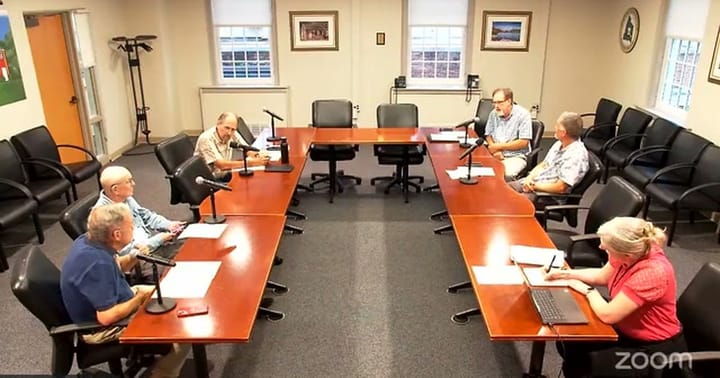
Other Committee · Meeting of September 17, 2026
Bloomfield committee reviewed trail and sidewalk progress, with a 2029 greenway target and a December roundabout meeting. Staff said a design contract was signed with BL Companies in August for the roughly 7,000-foot East Coast Greenway segment from the high school to Toby Road, with construction "optimistically" eyed for 2029. The Woodland Avenue sidewalk project has secured $1.5 million in funding, and construction on four Maple Avenue median islands, built by Mid State Development, begins next week.
A caller named Bob called the Seabury-area intersection "the worst" he's encountered and said he hopes "Seabury people can get to town without risking their life." The Connecticut Department of Transportation has scheduled a public information meeting on a proposed roundabout there for December at Town Hall. A member pressed staff for cost estimates on burying utility lines for the upcoming Grand Street project, citing Filley Park as a cautionary example.
In the full story:
- Who Was There
- Organizations And Documents Referenced
- The complete report — 2,864 words
Source: the Other Committee meeting of September 17, 2026, reported from the official video recording and transcript.
The Full Article
Terry Plains Road Trail
Background and stakes: The Terry Plains Road trail has an outstanding grant application to the Connecticut Forest and Parks Association, submitted earlier this year before two town staffers involved in trail work, identified in the meeting only as Rob and Dan, left town employment.
The question before the body: Whether the grant has been awarded and what work remains before design can proceed.
Substantive content: The presenter said no award has been announced. A phase-one walkthrough of the corridor took place on the 29th, a date referenced without a month attached in the discussion. The presenter said staff, including a colleague referred to only as Glenn, has been following up with the grant program and with other organizations, including the Metropolitan District Commission, to ensure continuity after the staffing change.
The deliberation: A member asked whether the presenter personally handles these grant follow-ups or works through a designer; the presenter said he is "following up" directly despite normally working through outside design consultants. No one on the committee offered additional information about the grant timeline.
Procedural steps and outcome: No vote or formal action. Staff agreed to continue monitoring for the grant decision.
Implications and what is next: Until the grant decision is announced, the Terry Plains Road trail cannot move into design. The committee did not set a follow-up date for an update.
Merrick Greenway: High School to Toby Road
Background and stakes: This roughly 7,000-foot trail segment is intended to become the primary East Coast Greenway route through Bloomfield, a status the committee adopted years earlier on the assumption that Hartford would choose a different route, the Griffin Line, for its own portion of the regional trail.
The question before the body: What is the design schedule and scope for the segment, and when could construction begin.
Substantive content: A design contract was signed with BL Companies in August. A project kickoff meeting took place that morning at the Department of Public Works, attended by BL and by VHB, the firm serving as liaison to the Connecticut Department of Transportation. Design is expected to take roughly a year to a year and a half; survey work, traffic counts on major roads and crossings, and railroad coordination have begun. The next milestone, a 15 percent design review, is expected in late fall at another DPW meeting. Most of the corridor will be rebuilt at 10 feet wide, replacing narrower existing sidewalks, except near an existing bridge on Park Avenue close to a residence members referred to as "Bonnie's house," where the path narrows to about 5 feet because rebuilding the bridge is not currently planned. The presenter said the town's separate Town Center at the high school project may shift the roadway south in one area to avoid a culvert crossing, which could allow the trail to avoid the narrow bridge crossing as well.
The deliberation: Members discussed whether the town could widen the road shoulder instead of rebuilding the bridge; the presenter said that option carries "additional cost" and is not likely at this location but is being used elsewhere along the corridor near the high school project. On the overall schedule, one member called a one-year design timeline "pretty aggressive," while the presenter agreed it is "doable" but "not a six month project."
"I mean, if we say September, year and a half from, you know, this month, is... I mean, it could be, maybe it's done in a year. You know, I think a year is pretty aggressive. You know, but doable." [00:28:08] — the committee's staff presenter
Procedural steps and outcome: No vote. The presenter said construction could realistically begin in 2029, calling that "optimistically" the target, while cautioning that acquiring any needed property rights through the state process could add six to eight months once maps are submitted.
Implications and what is next: The next concrete checkpoint is the 15 percent design review this fall. Property acquisition, if needed, remains an unresolved variable that could push the 2029 target later.
Town Center at Day Hill Road Trail
Background and stakes: This trail segment has seen no design progress. The project's viability depends on whether it can run alongside an active freight rail line or must instead follow an alternate inland route.
The question before the body: Whether to pursue Transportation Alternatives funding for design, and which route alignment to pursue given the active railroad.
Substantive content: The presenter said Transportation Alternatives funding, a periodic federal grant program, would be a strong fit for this project's design phase, and that the design firms working on the Merrick Greenway segment, BL and VHB, independently suggested the same funding source that morning. The alternate inland route would run along the west side of Tunxis Avenue, turn onto Adams and Boyson, cross land trust property into Reservoir 3, and continue to land trust property at Evans before descending into town, avoiding most railroad frontage. That alternate route would still need to cross a dike at Reservoir 3, an area the state Department of Energy and Environmental Protection treats cautiously for trail proposals, according to the presenter.
The deliberation: A member asked whether the alternate route avoids crossing Tunxis Avenue twice, a concern tied to an earlier, since-abandoned plan to start the trail near a different connector; the presenter confirmed the current concept avoids that double crossing by staying north of Boyson Street and not routing through Windsor.
Procedural steps and outcome: No vote. Staff said it will wait for the next Transportation Alternatives grant round, whose timing is unknown, before applying for design funding on this project.
Implications and what is next: This project remains undesigned pending both the grant cycle and the unresolved active-rail question. No date was set for the next update.
School Street Traffic Calming and Sidewalk Project
Background and stakes: This project, which extends a sidewalk to Seabury and includes traffic-calming measures, was previously reported as nearing 90 percent design completion.
The question before the body: Current design status and timeline to finish.
Substantive content: The presenter said the project is "a little bit less" than 90 percent complete currently, with that milestone expected to be finished in October.
Procedural steps and outcome: No vote; informational update only.
Implications and what is next: The project remains on track for construction discussion at a future meeting, tied loosely to the nearby roundabout proposal discussed below.
Seabury Street Roundabout
Background and stakes: The Connecticut Department of Transportation has studied a roundabout at the intersection near School Street and Winbury Boulevard for years as part of improvements tied to the broader Seabury-area corridor. Multiple speakers described the intersection as dangerous.
The question before the body: Status of the state's design process and the timeline for public engagement.
Substantive content: The presenter said DOT has not advanced the design beyond concept level since a call about two weeks before the meeting, but has scheduled a public information meeting for December at Town Hall. The presenter said DOT's internal ranking placed the intersection among roughly the top 10 of 30 to 40 candidate locations studied statewide for roundabouts, though the presenter was not certain of the exact rank, saying only "it might have been like fourth." The project also includes continuing a sidewalk along the corridor to Seabury, though widening the sidewalk further was described as not currently planned.
The deliberation: A caller identified as Bob, joining partway through the discussion, said the intersection was "the worst" he had encountered, describing near-misses from having to begin a turn before oncoming traffic clears, and said he recalled multiple crashes there. He said he once wanted to formally report the intersection as dangerous but that a former town manager discouraged it over liability concerns. A committee member who said they had lived in Bloomfield 33 years recalled thinking the intersection "should be a roundabout" the first time they drove through it, and described personal roundabout design training taken in Arizona through a county advisory committee. Another member recounted a family member crashing a car after taking the nearby turn at excessive speed years earlier. Members agreed the configuration was "a natural" candidate for a roundabout and discussed whether the design could be pushed forward faster, given anticipated construction on the nearby School Street project in 2027.
"We really look forward to the time when Seabury people can get to town without risking their life on the road." [00:28:38] — Bob, caller discussing the intersection
Procedural steps and outcome: No vote. The presenter said the project remains on DOT's internal schedule with a tentative 2029 timeframe, which multiple members called uncertain given how far out that is.
Implications and what is next: The December public information meeting at Town Hall is the next concrete opportunity for residents to engage with DOT on the design. Members asked staff to ensure sidewalk alignment for the nearby Woodland Avenue work does not conflict with the eventual roundabout footprint.
Woodland Avenue Sidewalk Project
Background and stakes: This project fills a sidewalk gap south of Ashley Street and extends sidewalk coverage toward the high school and Blue Hills Avenue.
The question before the body: Funding and design-phase status.
Substantive content: The project has been awarded $1.5 million in funding. Staff is developing a request for proposals for on-call consultants, expected to be issued next month, with the goal of starting design this year. The presenter described the route as relatively low-complexity, noting only one culvert extension as a significant challenge along an otherwise flat corridor.
Procedural steps and outcome: No vote; informational update.
Implications and what is next: Design is expected to begin before the end of the year, pending consultant selection through the forthcoming RFP.
Grand Street Complete Streets Project and Utility Undergrounding
Background and stakes: This project would add sidewalks on both sides of the street, along with decorative lighting, similar to an earlier project on Blue Hills Avenue that a committee member said predated current staff and did not include burying overhead utility lines, a decision the member said has left that corridor visually marred.
The question before the body: Whether the new project's scope and cost estimate should include burying utility lines, not just relocating light poles.
Substantive content: RFPs for the project are expected to go out within about a week. The presenter said current plans call for "leaving" existing utility infrastructure in place and trying not to move poles or bury lines, citing likely significant cost, though no specific estimate was presented at the meeting.
The deliberation: A member pushed back directly on the project's default approach, citing Filley Park as what the member called "the poster child" for a public space whose appearance is permanently compromised by overhead utility lines regardless of other beautification work.
"I would prefer that, at least in terms of, at the point of looking at RFP... to have an estimate of with and without. How much would it cost to bury these?" [00:37:46] — a committee member, on utility undergrounding
The presenter agreed to research the cost of undergrounding utilities and said a rough concept-level cost figure already exists that could incorporate the request.
Procedural steps and outcome: No vote. Staff agreed to return with a cost comparison for burying utility lines as part of the Grand Street project scope.
Implications and what is next: The requested cost estimate will likely shape whether undergrounding is included when the RFP responses are evaluated later this fall or winter.
Maple Avenue Median Islands Project
Background and stakes: This project adds median islands along Maple Avenue as a traffic-calming measure.
The question before the body: Construction status and schedule.
Substantive content: A construction contract has been signed with Mid State Development, a Bloomfield-based construction company. Construction is expected to begin the week after the meeting on four median islands, three located between Mountain Avenue and Burr, and one further south between Mountain Avenue and Cottage Grove. A raised intersection treatment at Sandpiper, similar to a speed table, is planned for construction the following year as part of the same original design.
Procedural steps and outcome: No vote; the contract itself was already executed before the meeting.
Implications and what is next: Construction begins within days of the meeting; the Sandpiper raised intersection follows in a subsequent construction season.
Regional Coordination: East Coast Greenway and Windsor Connections
Background and stakes: Bloomfield's greenway segments are intended to eventually connect to a broader regional network reaching Hartford and Windsor, but Hartford has not finalized its own routing decision between two options: the Griffin Line and a route through Toby Road.
The question before the body: How to stay informed on Hartford's and the region's planning decisions as Bloomfield's own segments move through design.
Substantive content: A member asked whether staff had been in contact with Caitlin Palmer, identified as a contact at the Capitol Region Council of Governments involved in a regional East Coast Greenway gap study examining the Hartford-area routing choice. The presenter said he had not yet spoken with her. The member recommended doing so, noting Palmer's prior work on the gap study positions her to clarify Hartford's intentions. Members also discussed a planned connector bridge across the Connecticut River to Windsor, which one member had personally biked across, and noted that Riverfront Recapture is separately developing a path network that could eventually link to Bloomfield's greenway. One member noted an informal understanding that DOT might run its own in-house project connecting Toby Road south to Route 44 near the University of Hartford area, though this was described as secondhand information.
Procedural steps and outcome: No vote. Staff agreed to add contacting Caitlin Palmer to a list of regional coordination follow-ups.
Implications and what is next: Until Hartford commits to a route, Bloomfield's own greenway segments will continue to be designed as the presumptive regional spine, per the presenter, without formal confirmation from Hartford.
New Business: Meeting Frequency
Background and stakes: A member raised whether the committee should meet more often than quarterly to get project updates sooner.
The question before the body: Whether to add interim meetings, such as video calls, between regular quarterly sessions.
Substantive content: The presenter said he already posts informal updates to a Facebook group focused on East Coast Greenway connectivity, and offered to make that information more consistently available between meetings.
The deliberation: One member said adding meetings would risk "meeting inflation" without meaningfully speeding up project timelines, given that most delays are driven by state and consultant schedules rather than committee input.
Procedural steps and outcome: No vote. The committee agreed to keep the quarterly schedule for now, with the presenter continuing informal Facebook updates between sessions. The meeting then adjourned with no additional public comment.
Implications and what is next: The committee's next regular meeting was not given an exact date in the discussion.
Committee members: Several members participated by first name only, with no roster supplied for this meeting to confirm full names, titles or officer roles; among those referenced were Joe, who raised the Windsor bridge connection, and an unnamed member who described 33 years of Bloomfield residency and prior roundabout design training in Arizona.
Staff: An unnamed Department of Public Works staff member presented project updates throughout the meeting. Two former town staffers involved in earlier trail work, referred to only as Rob and Dan, were described as having left town employment; a current colleague referred to only as Glenn was mentioned as continuing related follow-up work.
Public commenter: Bob, who joined partway through the meeting to discuss the Seabury-area roundabout and described a personal history with the intersection, including a family car crash years earlier; no affiliation beyond "resident" was stated.
Outside parties referenced but not confirmed present: Representatives of BL Companies and VHB attended a separate project kickoff meeting the same morning at the Department of Public Works, per the presenter's account; Caitlin Palmer of the Capitol Region Council of Governments was discussed as a contact to be made but was not reported as attending this meeting.
BL Companies — design firm under contract since August for the Merrick Greenway segment from the high school to Toby Road.
VHB — consulting firm serving as liaison between the design team and the Connecticut Department of Transportation on the Merrick Greenway project.
Connecticut Department of Transportation — reviewing right-of-way needs for the greenway segment and leading design of the Seabury-area roundabout, with a public information meeting set for December.
Connecticut Forest and Parks Association — recipient of a pending grant application for the Terry Plains Road trail.
Capitol Region Council of Governments — Caitlin Palmer, a staff contact there, was discussed regarding a regional East Coast Greenway gap study relevant to Hartford's routing decision.
Riverfront Recapture — organization developing a separate path network near the Connecticut River that could eventually connect to Bloomfield's greenway.
Mid State Development — Bloomfield-based construction company contracted for the Maple Avenue median islands project, set to begin construction the week after the meeting.
Metropolitan District Commission — referenced regarding coordination on trail-related matters following recent town staff departures.
Share this story
Know someone in Bloomfield who follows town government? Share Townbrief Bloomfield: they can sign up free.