Planning Commission Votes to Advance Draft Plan
Bloomfield's Planning and Zoning Commission voted to advance its final draft town plan, retitled "Plan for Bloomfield's Future."
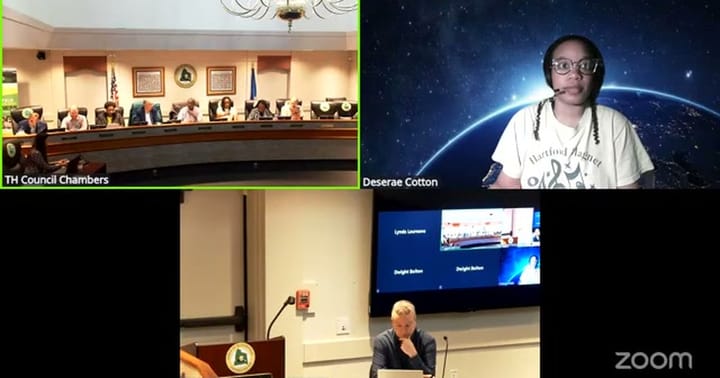
Planning and Zoning · Meeting of September 17, 2026
Bloomfield's Planning and Zoning Commission voted to advance its final draft town plan, retitled "Plan for Bloomfield's Future." The unanimous vote sends the document, the Plan of Conservation and Development, to the Capital Region Council of Governments and the Town Council for a 65-day review before a public hearing. Consultant Justin LaFountain of Goldman and York walked commissioners chapter by chapter through the state-mandated document. Commissioners struck a strategy that would have directed the town to "establish an agricultural zoning district," after Commissioner Roger O'Brien said the idea "has been debated and discussed and voted on three times." Commissioner Kevin Goff flagged that a staff-prepared economic table wrongly listed the town as employing 1,292 workers; officials said the actual figure is "about 650."
In the full story:
- Who Was There
- Organizations And Documents Referenced
- The complete report — 3,236 words
Source: the Planning and Zoning meeting of September 17, 2026, reported from the official video recording and transcript.
The Full Article
Call to Order and Roll Call
The Planning and Zoning Commission convened a special meeting at 7:03 p.m. to take up a single agenda item: the commission's final draft review of the Plan of Conservation and Development, known in the session as the POCD. A quorum of commissioners was present with one member, Eunice Medwinter, recorded absent. The meeting ran more than two and a half hours, moving chapter by chapter through the 10-chapter document with consultant Justin LaFountain of Goldman and York and town staff.
Chapter 1: Introduction
Background and stakes: The introduction had changed little since commissioners first saw it years earlier, according to LaFountain, and largely restates statutory requirements and the plan's compliance with the Capital Region Council of Governments' regional plan.
The question before the body: Whether the introductory chapter's narrative and supporting map accurately reflect current state guidance and the town's own engagement process.
Substantive content: Commissioner Kevin Goff said the chapter's text referenced "activity zones" drawn from the state's 2025-2030 Conservation and Development Policies Plan locational guide map, but the map's legend did not label them. A staff planner identified only by his first name, Nick, confirmed the zones appeared on the map without being named in the legend and said the fix was straightforward. Goff also objected to language describing the plan's public input process as "extensive," saying the original consultant held only one public session. Commissioner Jennifer Marshall Neely proposed renaming the document's cover from "Planned Bloomfield" to "Plan for Bloomfield's Future," and flagged wording issues, including a claim of "numerous" new apartment buildings in the town center that she said should read "several," and inconsistent references to the "Parks, Recreation and Leisure Services" department.
The deliberation: "I don't think two or three apartment buildings is numerous," Marshall Neely said, prompting LaFountain to agree to the word "several." Commissioner O'Brien noted he had circulated the state's locational guide map to commissioners months earlier. "You may recall that in March I sent you a link to the state plan," O'Brien said, adding the map "is the exact same" as the one now in the draft.
Procedural steps and outcome: No vote was taken; commissioners reached consensus that remaining edits were typographical and would be sent directly to staff rather than debated line by line.
Implications: The chapter's substance is largely locked in; remaining work is wording cleanup during the 65-day review.
Chapter 2: Executive Summary
Staff planner Nick told the commission the summary was rewritten in-house to give it "a more personal, local eye," updating 2023-era population data and adding a section on natural resources and sustainability. Commissioner Renee James asked that staff receive credit for that work, and Commissioner Marshall Neely sought clarification that the session was focused on substantive issues rather than minor wording, which staff confirmed. No votes were taken on this chapter.
Chapter 3: Natural Resources
Background and stakes: This chapter received the most substantial rewrite in the current revision cycle, according to LaFountain, including new material on sustainability, natural resource protection and greenways.
The question before the body: Whether the rewritten chapter's data, maps and policy goals are accurate and internally consistent.
Substantive content: Goff asked why a 2012 map showing farmland clusters had been dropped from the chapter, saying its removal left the plan's farmland-preservation goals without a map showing where viable farmland remains. Land Use Director John Coleman said the commission had previously decided that farmland information should instead appear on the future land use map, but that it had since been removed from that map as well. Goff also flagged that a Connecticut Department of Energy and Environmental Protection water-quality rating shown for the north branch of the Park River appeared mismatched with its description as not supporting aquatic life or recreation, and noted the plan's East Coast Greenway map still showed the trail routed over Route 185, which LaFountain and staff acknowledged was outdated.
The deliberation: Commissioner O'Brien urged the commission not to delay the document over mapping gaps. "We can't let perfect be the enemy of the good," he said. On policy language, O'Brien said a goal to "preserve valuable agricultural land through zoning regulations" should have those two words removed because the town cannot currently use zoning to protect farmland. Commissioner David Millett raised a related concern about an agritourism strategy, saying revised language should say the commission will "consider" revising regulations rather than commit to doing so, given that agritourism proposals have been rejected by the commission twice before. Goff then proposed creating a dedicated agricultural zoning district, prompting O'Brien to say the idea had already been raised and declined.
Procedural steps and outcome: Commissioners reached consensus, without a recorded vote, to strike "zoning regulations" from Goal 3 and to swap "lead" and "partner" roles in two strategy tables so the commission, not staff, is listed as responsible for agricultural and land-use regulation reviews.
Implications: The agricultural zoning question carried forward into the cultural resources chapter discussion later in the meeting.
Chapter 4: Housing
Background and stakes: The housing chapter sets goals for housing diversity, senior housing and affordability, informed by census and American Community Survey data.
The question before the body: Whether housing goals are clearly defined and whether the data underlying the chapter matches its own charts.
Substantive content: Commissioner James said the chapter uses the phrase "diverse housing options" repeatedly without defining it, and asked that the plan clarify it refers to housing type, not demographic diversity. She also objected to a strategy supporting housing diversification "without adversely impacting single-family neighborhoods," calling the phrase too broad. Commissioner Goff raised a series of data mismatches: a stated median household income of $98,725, which he said did not match the accompanying chart; a cited 8.4 percent Hispanic and Latino population figure against a chart showing 7.9 percent; and a 24.9 percent foreign-born estimate against a chart showing 22.6 percent, among others spanning pages 45 through 51 of the draft.
The deliberation: "The numbers don't tie up. They don't tie to the tables," Goff said, adding that charts and narrative text appeared to draw from different data sources, American Community Survey figures in one place and Census Quick Facts in another. LaFountain agreed, saying the mismatches likely occurred when more current chart data was substituted after the narrative text was finalized. Commissioner Steven Millett asked that color-coding be made consistent across repeated chart series. A resident's proposal for container-home development, raised by Commissioner James, prompted discussion of whether to explicitly add "innovative housing design," including container and tiny homes, to the diversification strategy; LaFountain said that was a policy choice for the commission.
Procedural steps and outcome: No vote was taken. Commissioners reached consensus that staff would reconcile narrative figures with chart data using the more current source, revise the "adversely impacting" language, and add language on innovative housing design.
Implications: The housing chapter's final language affects what the plan recommends for future zoning amendments on accessory dwellings, multifamily development and senior housing.
Chapter 5: Business and Economic Development
Background and stakes: This chapter sets economic development goals and presents labor-market and taxpayer data drawn from town financial reports and commercial data sources.
The question before the body: Whether the chapter's economic tables accurately reflect town employment and the commercial tax base.
Substantive content: Goff said a table drawn from the 2024 Comprehensive Annual Financial Report wrongly stated Bloomfield employs 1,292 workers. "Town of Bloomfield does not employ 1,292 workers. We employ about 650 people. That's a mistake in the annual financial report," he said, pointing to employee totals elsewhere in the same CAFR. He also said the plan's top-taxpayer table should be consolidated, since entities are often listed under separate corporate names and separate real estate and personal property accounts; he cited Eversource as the largest taxpayer, with HomeGoods at $82.2 million (listed under "HG Con Realty Corp."), Niagara at $65.3 million and Trader Joe's at $64.9 million. He further flagged that an employment inflow-outflow diagram on page 59 and a related "where Bloomfield residents work" table on page 60 did not reconcile, because Bloomfield itself was folded into "all other locations" rather than broken out, obscuring that the town is the second-largest employer of its own residents.
The deliberation: Commissioner James said the chapter focuses heavily on large employers and asked that staff consider language supporting small businesses, citing a neighbor who received a zoning violation for parking a business truck at his home. "I think a goal of ours should be to look at our regulations and make sure that they're not prohibitive to small businesses," James said.
Procedural steps and outcome: No vote was taken; staff agreed to correct the employee count, consolidate the taxpayer table, and consider small-business language in the permitting strategy.
Implications: Accurate labor and tax-base data underpins the plan's economic development goals heading into the public comment period.
Chapter 6: Mobility
This shorter discussion focused on factual corrections rather than policy. Commissioner Marshall Neely questioned a claim that Bloomfield has close highway access to Interstate 84, which LaFountain agreed was debatable from an economic-development standpoint and recommended narrowing. Commissioner O'Brien suggested noting that residents can reach Bradley International Airport by connecting bus service. Goff identified a roadway-mileage inconsistency, noting the chapter cites 140 miles of state and local roadway in one place and 104 locally maintained miles in another, producing a flawed per-resident cost comparison with Hartford County. "I felt like I needed to pull out a calculator to figure out what was going on," Goff said. Commissioners agreed to delete the comparison passage rather than attempt to fix it. Commissioner James asked that funding for the town's traffic-calming program be raised to "high" priority, which drew no objection.
Chapter 7: Facilities and Services
Background and stakes: This chapter covers municipal buildings, schools and utility infrastructure, several of which have changed since the chapter was last drafted.
The question before the body: Whether the chapter reflects current conditions, including recent school closures and the commission's statutory role in capital budgeting.
Substantive content: Commissioner O'Brien said state statute gives the Planning and Zoning Commission a role in the capital budget process, and asked that the commission be added as a "partner" entity in that strategy alongside the Town Council and finance department, which the commission supported. Goff said the chapter still lists seven schools when the town now operates five, following the closures of the Global Experience Magnet School and Carmen Arias School. He asked staff to update enrollment language to match figures discussed earlier in the population chapter. Commissioners also noted the Board of Education's central office remains at 1133 Blue Hills Avenue for now but will relocate to the former Carmen Arias building by the end of the fiscal year, and the town should begin considering reuse of both the Blue Hills Avenue building and the former magnet school site. On utilities, Goff asked that an electric hosting-capacity map and a solar-permit map, both maintained by staff, be added to the chapter alongside existing water and gas sections; staff planner Nick agreed to provide updated versions but cautioned the hosting-capacity data changes frequently.
Procedural steps and outcome: No vote was taken. Commissioners agreed the school and facilities updates, along with the capital-budget partner designation, should be made before the document goes out, while new maps can be added during the 65-day review without holding up transmittal.
Implications: The facilities chapter's accuracy affects how residents and officials read the plan's picture of school consolidation and future municipal building use.
Chapter 8: Cultural Resources
Background and stakes: This chapter addresses historical and cultural assets and reopened the agricultural zoning question first raised in Chapter 3.
The question before the body: Whether a strategy directing the town to "establish an agricultural zoning district" should remain in the plan.
Substantive content: Commissioner O'Brien asked to delete Strategy 4.7 entirely, saying the commission had already decided not to create a dedicated agricultural zone. Goff objected to removing the language before the public hearing, arguing residents should have a chance to weigh in.
The deliberation: "We have never had a meeting where we have discussed having an agricultural zone. We have never had an open discussion on that, nor could we have had a vote," O'Brien said, adding that Goldman and York had also recommended against a dedicated agricultural zone. Goff responded that the commission had discussed the concept "in the context of the future land use map" rather than voting it down outright. Staff planner Nick noted that agriculture is already a permitted use "by right" in every zoning district, reducing the need for a dedicated district. Commissioner Leon Peters asked whether the surviving Strategy 4.2, which calls for dialogue with local farmers on zoning amendments to preserve farmland, already captured O'Brien's intent; O'Brien agreed it did.
Procedural steps and outcome: Commissioners reached consensus, without a recorded roll-call vote, to strike Strategy 4.7 in full. A related strategy, 4.4, was revised to say the commission will "consider" rather than commit to revising regulations for farm accessory uses such as agritourism.
Implications: The deletion removes the plan's only explicit reference to a future agricultural zoning district, though the underlying policy question may return in a future planning session, as Goff said he intends to raise it again.
Chapter 9: Future Land Use
Background and stakes: Commissioner O'Brien said he had worked for roughly a year and a half to correct language describing the future land use map's legal status, which he said draft text incorrectly characterized as merely advisory.
The question before the body: Whether to adopt O'Brien's rewritten narrative describing the map's statutory basis.
Substantive content: O'Brien proposed replacing a full paragraph on page 107 that said the future land use plan "is not" a regulatory tool, substituting text stating that under Connecticut General Statutes Section 8-23, the commission must provide a map depicting appropriate and desired land uses, and under Section 8-3a, the commission consults that map when determining whether proposed zoning amendments or district changes are consistent with the plan of conservation and development, and must state on the record how any such change is consistent with the plan. He also asked that an opening sentence on page 108, which stated land use is "based upon the town's zoning districts and existing land uses," be deleted because he said the relationship runs the opposite direction.
The deliberation: Goff separately asked that generic category names on the future land use map, including "Open Space 1," "Open Space 2," "Mixed Use 1" and "Mixed Use 2," be renamed to more descriptive terms. O'Brien objected, saying the commission had already voted to adopt those category names. "We've already adopted the names," O'Brien said, while Goff maintained he had voted no on that naming decision and wanted it revisited. The commission did not reach consensus to rename the categories at this meeting.
Procedural steps and outcome: Commissioners agreed to adopt O'Brien's rewritten statutory language for pages 107 and 108, pending written review. No vote was taken on renaming the land use categories.
Implications: The revised language strengthens the stated legal weight the commission gives the future land use map in future zoning-amendment reviews.
Chapter 10: Summary and Final Vote
Background and stakes: The final chapter summarizes the plan and lists implementation steps tied to chapters already reviewed. Commissioners also addressed a credit line crediting the document's original author.
Substantive content: LaFountain said no edits had been submitted for the summary chapter itself, since its content is linked to each chapter's individual goals. Commissioner O'Brien proposed revised credit language reading that the plan was "originally researched and drafted by FHI Studio, revised by the Planning and Zoning Commission together with commission staff, and assisted by Goldman and York advisors," which he said FHI Studio contact Francisco Gomes had approved. Staff also noted an outdated reference to former Town Clerk India Rogers, who has since moved into a different role, would be corrected.
The deliberation and outcome: Commissioner O'Brien then moved "that we send the document as amended tonight, direct the staff to send it to the Capital Region Council of Governments and the [Town] Council, and notify other parties as required," specifying that during the ensuing 65-day review period staff may correct misspellings, data inconsistencies between narrative and charts, and add agreed-upon maps without returning the document to the commission, and that staff provide commissioners a corrected version seven days before the public hearing date. The motion was seconded, with the transcript indicating Commissioners Millett and Marshall Neely both offered seconds at nearly the same moment. The commission then voted by roll call; audible votes were uniformly affirmative, with no recorded opposition.
Implications and what is next: The vote starts the 65-day regional and town review required before the commission can schedule a public hearing on the plan. Town council packet materials for the council's next meeting were due to the town manager by September 21; officials said the plan's full review and transmittal to the council would occur separately from that packet deadline, with the public hearing date to be set once the review period concludes.
Commissioners present: Kevin Goff, Roger O'Brien, Renee James, Jennifer Marshall Neely, David Millett (roll call also listed a "Steven Millett," possibly a duplicate entry from a commissioner logged into two devices), Leon Peters, Dwight Bolton (left partway through the meeting), Commissioner Cotton, and a commissioner recorded in roll call as "Firon Lester," whose role in the discussion could not be confirmed. Eunice Medwinter was recorded absent.
Staff and consultants: Justin LaFountain, senior vice president of planning and economic development, Goldman and York (consulting firm; name also rendered "Goldman York" and "Gorman and York" in the transcript); a staff planner referred to as Nick, who described himself as the town's environmental planner; a staff member referred to as John, addressed at one point as "Director Coleman," apparently the town's land use director; and a staff member referred to as Linda, role unspecified.
Outside parties referenced: Francisco Gomes of FHI Studio, the original author of the plan, consulted by phone regarding credit language.
Capital Region Council of Governments (CRCOG), referred to colloquially as "Krog" — regional planning body that will review the draft plan during the 65-day period before the public hearing.
FHI Studio — the original consulting firm that drafted the prior version of the Plan of Conservation and Development, now credited alongside Goldman and York and commission staff.
Connecticut General Statutes Section 8-23 — cited by Commissioner O'Brien as the statutory requirement that the commission include a future land use map in the plan.
Connecticut General Statutes Section 8-3a — cited by Commissioner O'Brien as requiring the commission to consult the future land use map and state on the record how proposed zoning changes are consistent with it.
Town of Bloomfield 2024 Comprehensive Annual Financial Report (CAFR) — cited by Commissioner Goff as the source of an incorrect employee count (1,292) used in the draft's economic development chapter.
Connecticut Department of Energy and Environmental Protection (CT DEEP) water-quality classification data — cited in the natural resources chapter's discussion of the Park River rating and questioned by Commissioner Goff.
State of Connecticut 2025-2030 Conservation and Development Policies Plan — the source of the "locational guide map" discussed in Chapter 1, whose legend commissioners said needed updating.
Share this story
Know someone in Bloomfield who follows town government? Share Townbrief Bloomfield: they can sign up free.